It’s instructive how two separate and distinct paradigms can merge together in unison. The Celtic tradition of Samhuinn (sow-en) and the Church’s recognition of All Saint’s Day is a time when pagan and Christian thought converge.
Setting aside the days by calendar, and reckoning with the days by season gives a different perspective. One more in keeping with nature and the natural world around us. For that is where we truly live, without all the artifices of present-day technology. Such simple and basic qualities are far more inherent in us than first realized, for our roots are planted deep within the elder-days. And we retain the capability to respond and recall them to mind.
Samhuinn – meaning ‘summer’s end’ marks the beginning of the dark time of the year. For the Celtic calendar divides in two – light and dark. The light half begins at Beltainne on May 1st. So, we still have a way to go yet.

Presently, we are mid-point between the Autumn Equinox where the hours of day and night are equal, and Winter’s Solstice when the light of day begins to gradually outpace the hours of night. The harvest is over, the livestock stabled, and the cold sets in. Our activities tend to be more sheltered due to inclement weather. Consequently, we turn more inward. Thus allowing for a greater time of thought, reflection… and memory.
October 31st marks the end of the Celtic ‘calendar’ year. November 1st marks the start of a new year. Therefore, from dusk to dawn there is no time. It is a liminal zone, a threshold in-between. One door has closed, and the new door has yet to open. Within this space that is considered ‘no time’, spirit and matter approximate, becoming more closely aligned. Their separateness and boundaries fading.
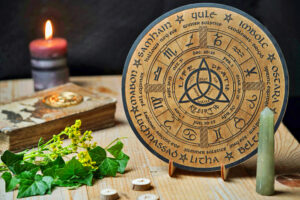
In Celtic thought, the veil between this world (matter) and the ‘other world’ (spirit) becomes thin enough for spirit and matter to meet. It is believed that with the veil so thinned, loved ones now gone can pass through, and once again walk with us during these few hours.
And so, candles are lit and favourite foods laid out. The spirit of our loved one’s notice, and knowing they are not forgotten – draw near.
There is a comfort in this tradition. To think that by such simple actions, we can bring about a greater awareness of their presence with us. That their spirit can merge with our matter, thus allowing us to ‘know’ them once more.
Naturally, the Church took exception to this particular practice. And as Christianity spread further across widely divergent lands, local pagan traditions needed to be weeded out. The ‘old ways’ replaced with new ways. Ones which were more acceptable, and in keeping with this fledgling religion trying to establish a foothold in society.
And so, in the 4th century Pope Gregory declared November 1st as All Saint’s Day, followed by All Soul’s Day on November 2nd. A time to recognize and honour the saints of the Church. It eventually also came to include those loved ones, now departed.
This was done by the lighting of candles, symbolizing the light of Christ. For even in Christianity, there is a strong belief in the spiritual bond between those now living, and their loved ones who have passed.
Two separate cultures, two different ways of thought… that are maybe not so separate and different after all.
It is no coincidence that both these traditions choose this time of year to honour loved ones now gone. For with winter upon us, the harvest completed… nature, in a sense, is dying. And regardless of time passing, our roots still lie within this agricultural/agrarian community of thought.

With this passing of time, we too move on. Leaving behind the place and space once shared with those we love. For time has closed the door behind us, and they can no longer follow along. We remain matter, they are now spirit. And that separateness creates what feels like a void which cannot be filled.
Every minute of every day, moves us further and further away from where and when they were walking beside us. The heart longs for their presence, even as the mind comes to the realization that this is no longer possible. It is called grief, and we ache with the loss this void engenders. Time, in its healing way, will temper the pain. This is of comfort. But still, they are missed in so many ways.
And never more, then when the days darken and the nights grow long and cold. The bleakness outside mirrors the emptiness inside, as losses we have known resurrect once more in memory… and heart. Such is the nature of life, for loss must have its way before the healing can begin.
Therefore we again, even if simply in memory, acknowledge and remember those whom we have loved… and who returned our love in such measure.
So, here we are halfway to the Winter Solstice, when the light of day will gradually overcome the darkened hours. Seasons are cyclical, in constant motion. And we can take heart from this. For as the dark of night does not last forever, neither do the empty feelings of grief. They have their place in time, to be sure, but then move on… as do we.

October 31st or November 1st … regardless of religion or traditional thought and lore, we light a candle. A small, yet simple, reminder that the darkness does not hold sway forever.
Spring will indeed come again in time, bringing with it brighter days, a lighter countenance… and the promise of life yet to be.
Time may pass and move us along with it… but it cannot separate the heart from those whom we have known and loved.
“Those whom we love and lose are no longer where they were before.
They are now wherever we are”
Amen
(St. John Chrysostom)