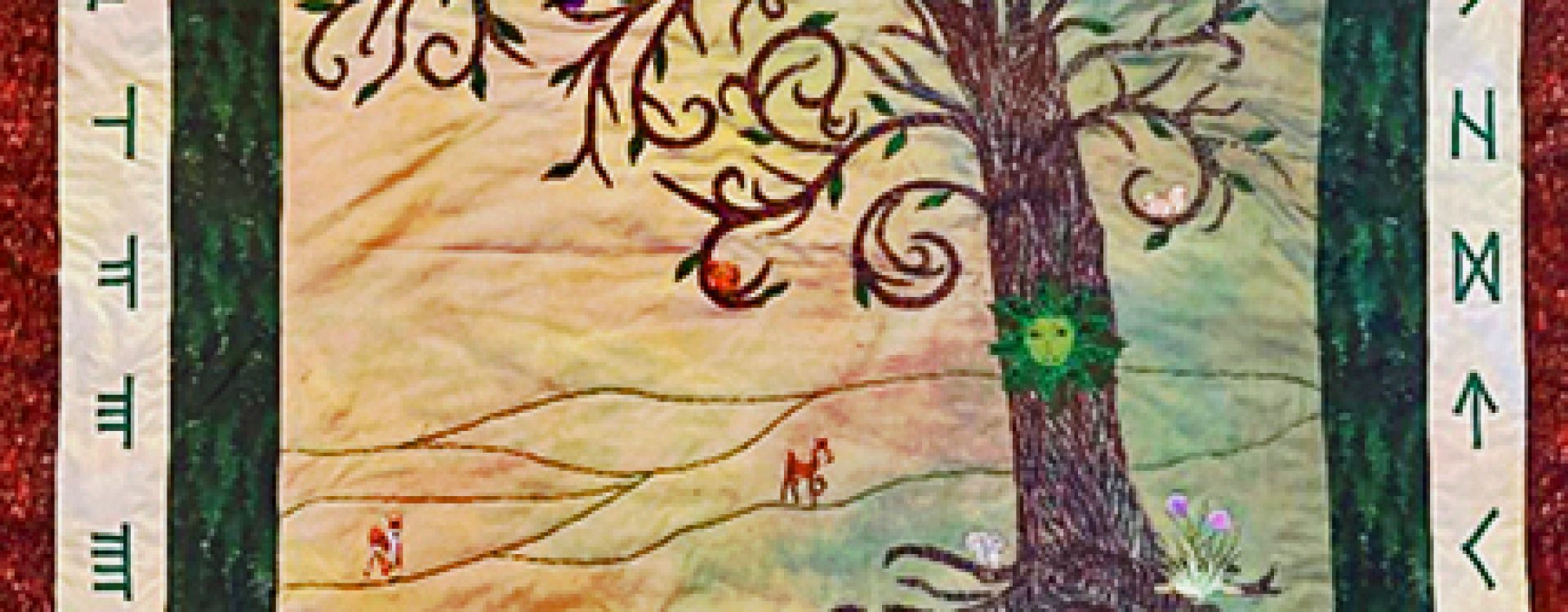
The Tree of Life has been depicted in numerous variations down through the ages. It is rooted in many of the world’s myths, traditions and religions. And has come to represent the interdependency and connectedness of life between human and animal, plant and spirit. A reflection of the abundant blessings God bestows upon His Creation, regardless of creed or nationality.
This particular rendition is Celtic in presentation, as that is my own heritage. And many symbols corresponding to such have been incorporated into the piece. Yet even so it remains universal, for that is its nature.
Theologians view the Tree as a symbolic description of Christ spiritually feeding his flock. For we have those verses in the Bible wherein Christ states, “I am the vine…” and “I am the bread of life.”
Therefore, within Celtic lore the Tree is known as Crann Beithadh, or The Feeding Tree. Its branches reaching ever higher into the sky, as its roots sink even deeper into the ground. This portrayal emphasizes the connection between heaven and earth, mind and body. A symbol of continual nourishment for the soul.
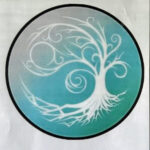
With so many different depictions of the Tree of Life, the first step was to decide which one resonated the most with me… and then go on from there. This would provide a starting point, and allow for my particular version to eventually assume a shape and form uniquely my own. Sometimes you have to let go and just trust the process.
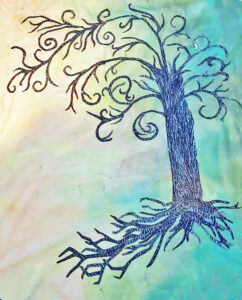
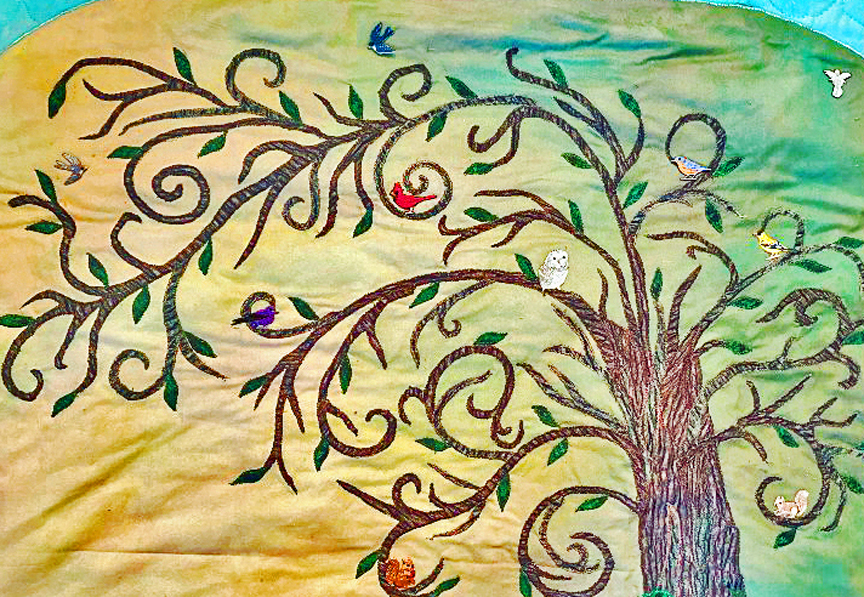
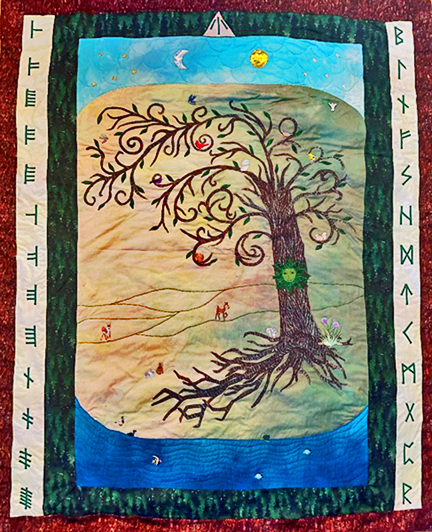
So, finding what is known as an ‘ombre’ fabric which contained a variety of earth-like tones, I used this as a base upon which to build the Tree. The background had to be simple and rather bland, so as not to compete with the Tree design. But rather, allow the Tree to stand out first and foremost. After that, it was just a matter of letting imagination take hold and watch as my pencil began to make branches and roots swirling around in an interlaced design.
Once the Tree was sketched onto paper, it was then cut out and laid on top of the material as a template for placement and construction. Two different fabrics were used to make the tree. Both were bark-like renditions; one in shades of brown and the other in shades of grey. Double-sided fusible web was used to adhere the fabric of branches and roots into place until they could be stitched. That gave me leeway to move things around a little bit, the better to figure out a more pleasing presentation.
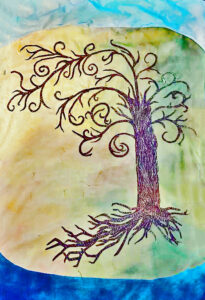
However, once the Tree was set into place using clear monofilament thread, the question arose as to what comes next? Sometimes I only see or can imagine one step at time. And that was the case here. There had to be some context. Earth, sea and sky; how to depict this was the next step. The earth is round, so no straight lines here. Keeping in mind that circles can be tricky to sew… I settled for curves – much easier.
And so, yet another ombre fabric was chosen for the sea. One in varying shades of deep blue with a tinge of green. For the sky, a lighter, more turquoise-like ombre fabric was a good fit. They were cut on the curve to give a hint of roundness to the earth fabric. Otherwise remaining straight-edged, so the quilt itself would be square, or in this case, take on a rectangular shape when completed.
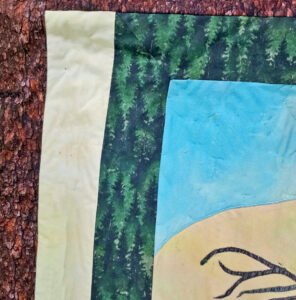
Now it was a matter of adding the borders. With all the various landscape type fabrics now available to choose from, this has been a boon to quilters such as me. So, I chose a deep green fabric for greater contrast, and if you look closely, you can see a pattern of pine trees depicted within. Perfect! A tree fabric for a tree quilt. Really drives the point home, providing a solid sense of continuity.
Because it is a Celtic depiction, I needed to be able to show this somehow. And what better way than with the ancient Ogham tree alphabet. Irish in origin, it was easier to carve on tree or stone because the symbols were made up of straight lines. Each month of the year was assigned a tree whose characteristics best described it. The ancient Celts were an agrarian community and followed a lunar calendar which gives 13 months rather than the 12 used today. This is also known as the Beth-Luis-Neon (be-loos-nean) alphabet. For example: Beth is the birch month and begins the year Dec 24 – Jan 20. Luis is the month of the Rowan tree, Neon belongs to the Ash tree, and so on.

Then further enhancing the Celtic aspect, the Futhark alphabet was added. When the Vikings settled up and down the British Coasts and along the Islands, they brought this runic based alphabet with them. Over time it became incorporated into the culture. And like the Ogham, the straight lines made it easier to carve inscriptions. Paper not necessarily being an option in ancient days.

Now to complete the base of the quilt, a final border was added to frame these various components, helping to further tie them all together. This outer border was a deep brown bark-like fabric in keeping with the overall tree theme. What better?
Once these borders were added, the quilt could then be sandwiched with batting and backing. Then began the process of top-stitching which would bind all three layers together.
The tree trunk, branches and roots were all outlined using a satin-stitch in both brown and grey threads. This helps give a smoother definition to the various curves and angles that comprise the shape of the tree.
Curved lines were stitched across the sea fabric to denote wave action.
Half circles quilted on the sky helped give the impression of clouds.
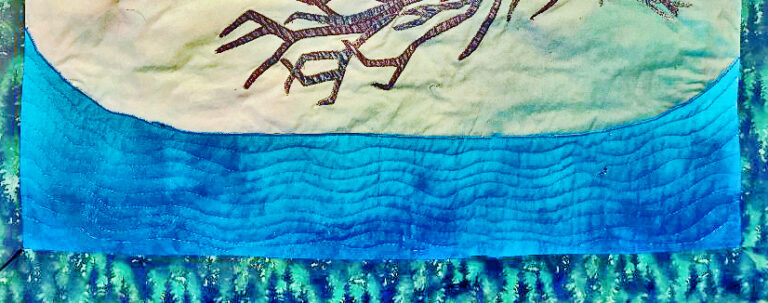
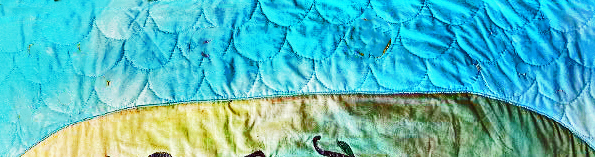
With the main sections of the quilt now completed, even finer details could be added. This would individualize the piece even more, allowing it to become a greater reflection of my own heritage, personality, and character. The hard work was done. Now I could let imagination soar and have a little fun with it all!
Where to begin? Let’s start with the earth. Again, there has to be a little context. The Tree is not just hanging out there somewhere; it needs to be grounded. A few simple embroidered lines across the fabric give a little depth and shape, making a big difference here.
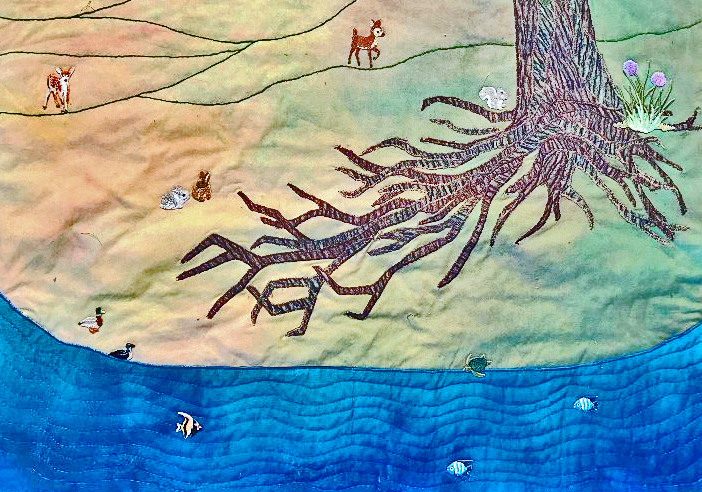
Embroidered patches were then placed and stitched. Deer, fawn, squirrels and rabbits, add a little character to the piece. Calling up fond memories of many a camping trip from the years past.
There are fish in the sea, ducks and turtles feeding nearby. Sights that were common viewing when canoeing on lake or stream. Again, allowing for memories of pleasant and enjoyable days to surface. Remembrances such as these can be soothing, for they recall a time when life was much simpler and easier to cope with.
Moving along – a few token leaves were added to round out the tree. Birds, more squirrels, and even an owl were stitched onto the different branches. My father’s totem of a cardinal was given a place – a sweet reminder of his presence still with me. Wrens, blue jays and a robin can be seen here. Some sitting on the tree branches, others flying nearby. A little angel in the upper right corner can be seen watching over everything, further adding a touch of character to the piece.
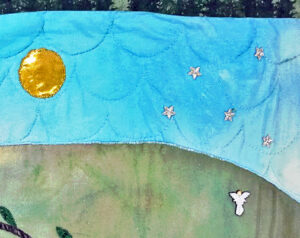
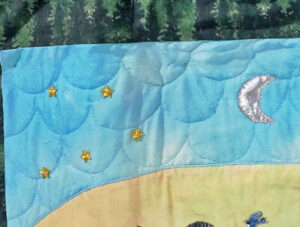
And then there is the sky itself. That too needed detail. So, I added a gold-yellow sun made from shiny lame fabric to one side of the sky. And on the other side, a silvery crescent moon, also from lame fabric which gives it a matching sheen. Small yellow stars accompany the moon, and tiny silver stars surround the sun.
Opposites – which offer an interesting contrast. Three stars of each colour, for that is considered a sacred number in Celtic lore. Representing wholeness and balance…completeness. This is what I wanted the quilt to embody. A harmony of earth, sea and sky. Nature at its best and at peace.
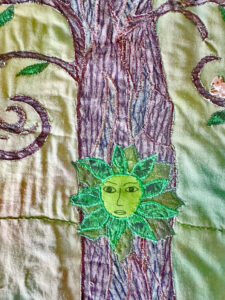
And of course, no Celtic Tree of Life would be complete without the Green Man. Therefore, within the trunk of the tree itself is this ancient symbol of rebirth and the cyclical renewal of life, which features so prominently in Celtic lore and mythology.
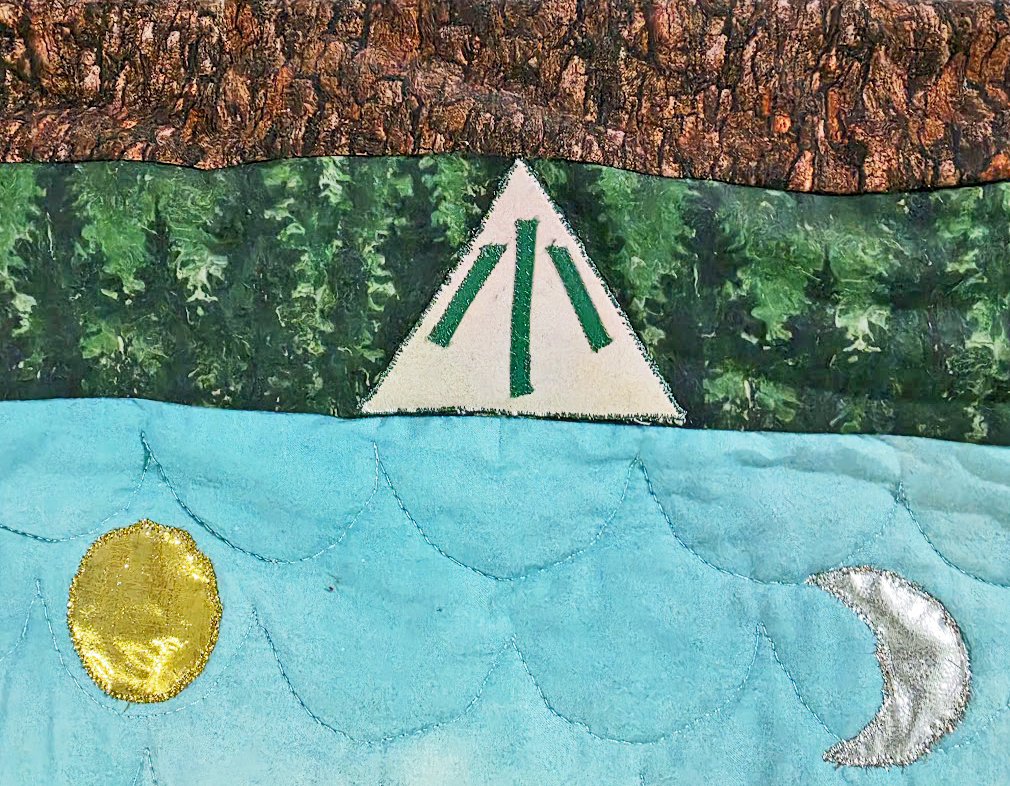
Situated at the very top of the quilt, watching over all, is a depiction of the Celtic Awen… symbol of inspiration. It is also a reminder of God’s creative nature. The Awen’s three strokes are reminiscent of the Triune parts of the Divinity, and offer a balance to the pagan aspects of the quilt.
You can see how the two cultures intersect here.
And so, my Tree of Life is as complete as it can be – for now. The quilt offered a chance to let whimsy have its way, and explore where this would take me. It was a light and fun piece to do. One which I enjoyed the challenge of making, as well as designing my own patterns.
Stretching beyond one’s comfort zone sometimes is necessary in order to grow; further discovering and uncovering different aspects of yourself. Even at my age (lol) I am still learning new sides to the art of being me! And ideally, that’s the way life should be – dynamic, ever moving forward and onward.
I believe there is a Tree of Life inside each one of us. We feed and nurture it with our words and deeds. In turn, it offers a sense of wholeness and stability, to better help us walk this uncertain path of life with a sure and steady step.
The troubles of today cannot touch or stunt its growth, for this Tree within is spiritually sustained not only by our hearts and souls… but by “streams of living water,” as found in John 7:38.
And now, the question is… what would your Tree of Life look like? Food for thought, hmm?!